
 Time:2024-05-29
SPEAKER BIOGRAPHY
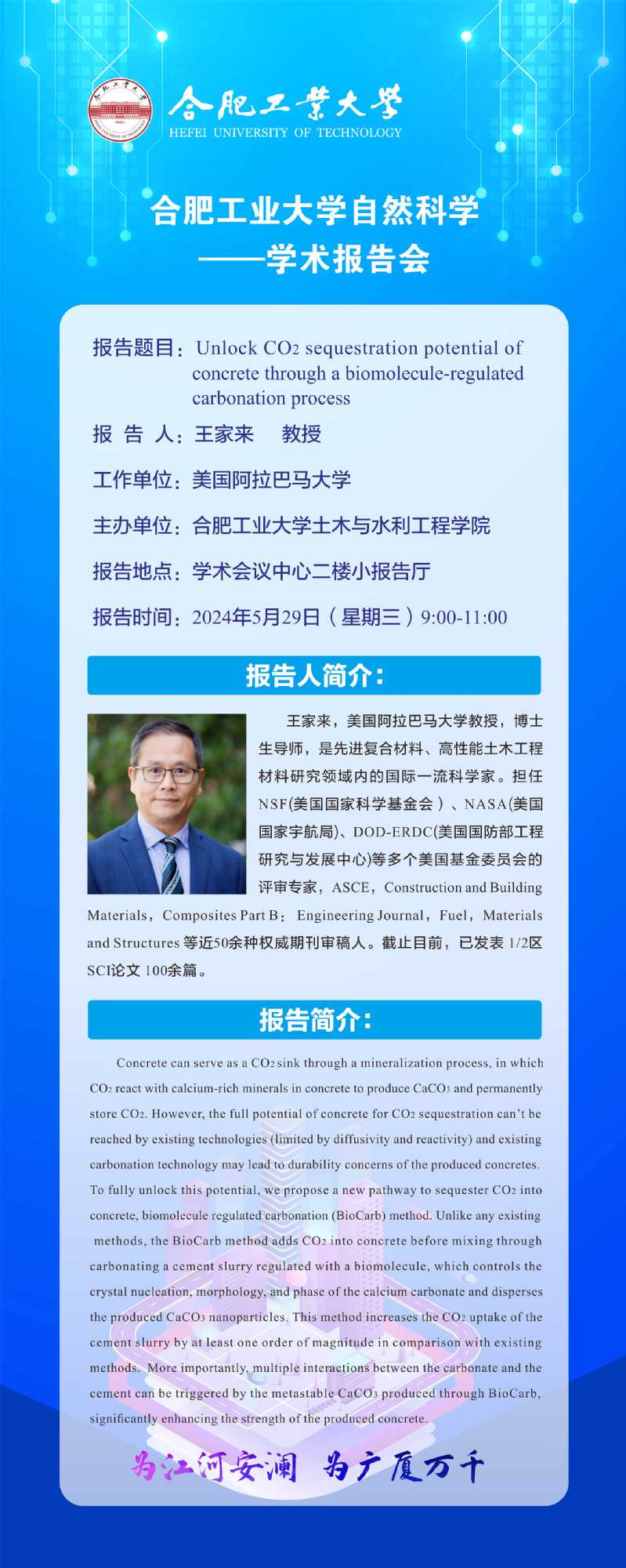
WANG Jialai is a professor and doctoral supervisor at the University of Alabama, USA. He is a world-class scientist in the research fields of advanced composite materials and high-performance civil engineering materials. He serves as a review expert for several U.S. funding committees, including the NSF (National Science Foundation), NASA (National Aeronautics and Space Administration), and DOD-ERDC (U.S. Army Engineer Research and Development Center). He is a reviewer for over 50 authoritative journals such as ASCE, Construction and Building Materials, Composites Part B, Engineering Journal, Fuel, and Materials and Structures. To date, he has published more than 100 SCI papers in Q1 and Q2 journals.
BRIEF INTRODUCTION
Concrete can serve as a CO2 sink through a mineralization process, in which CO2 react with calcium-rich minerals in concrete to produce CaCO3 and permanently store CO2. However, the full potential of concrete for CO2 sequestration can't be reached by existing technologies (limited by diffusivity and reactivity) and existing carbonation technology may lead to durability concerns of the produced concretes. To fully unlock this potential, we propose a new pathway to sequester CO2 into concrete, biomolecule regulated carbonation (BioCarb) method. Unlike any existing methods, the BioCarb method adds CO2 into concrete before mixing through carbonating a cement slurry regulated with a biomolecule, which controls the crystal nucleation, morphology, and phase of the calcium carbonate and disperses the produced CaCO3 nanoparticles. This method increases the CO2 uptake of the cement slurry by at least one order of magnitude in comparison with existing methods. More importantly, multiple interactions between the carbonate and the cement can be triggered by the metastable CaCO3 produced through BioCarb, significantly enhancing the strength of the produced concrete.
 Tel:0551-62905590
 E-mail:civil@hfut.edu.cn
 QQ Group:945051143
 Add:No. 193, Tunxi Road, Hefei City, Anhui Province

Department of civil and hydraulic engineering of hefei university of technology institute of international engineering education center @ all rights reserved


